In traditional Chinese birthday rituals, a scroll painting of Shou Lao (God of Longevity) hung in the centre of the main hall often serves as the visual and spiritual focal point of the entire ceremony. The old immortal of the South Pole, with his prominent forehead and snow‑white beard and eyebrows, not only embodies the ultimate human aspiration for health and longevity, but also, through the various objects he holds in his hands or has by his side, builds a complete system of auspicious symbols. Today, let us decode the profound traditional culture and beautiful wishes hidden behind these objects.
—
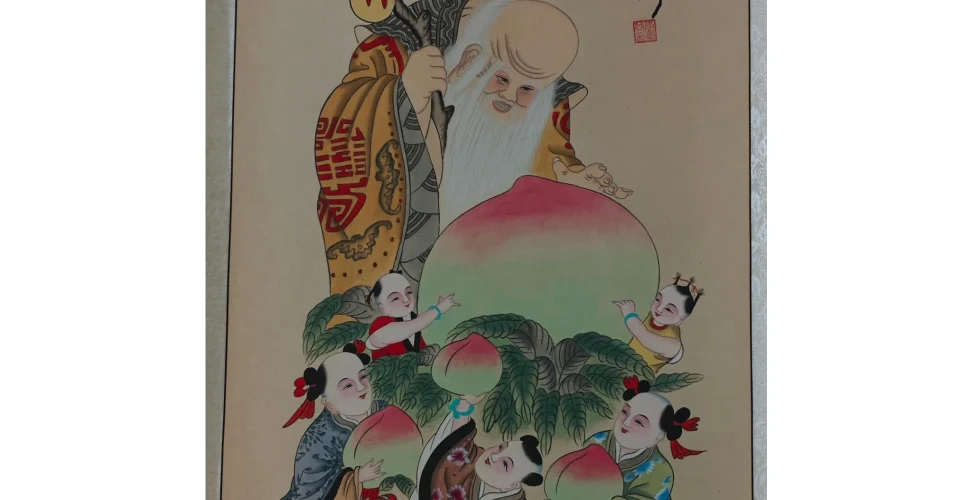
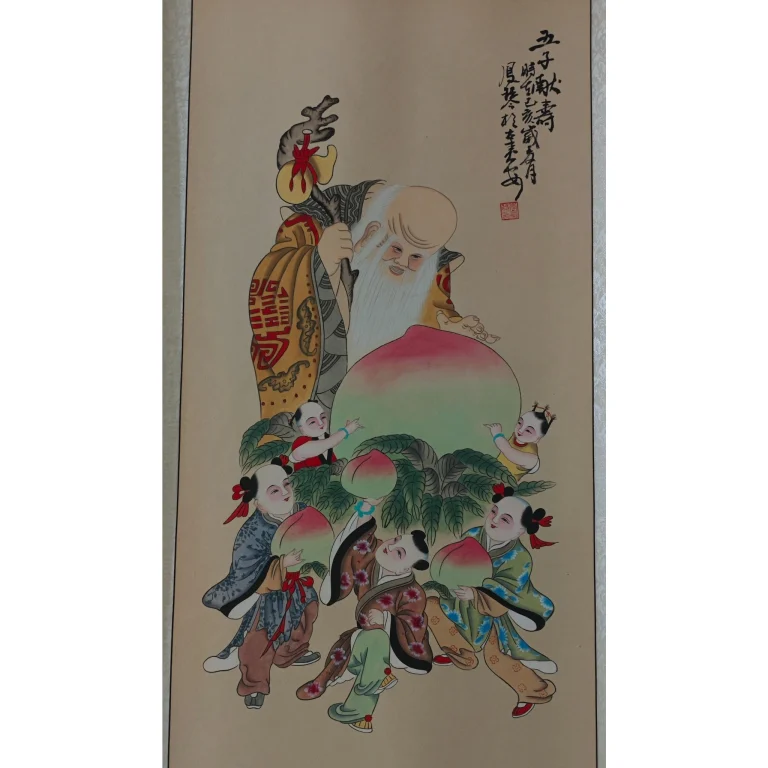
Shou Lao (God of Longevity) paiting have Immortal Peachs ,it is The Ultimate Aspiration of for Eternal Life .
In Chinese mythology, the peach is an absolute synonym for longevity. It is said that the Queen Mother of the West hosts a peach banquet at Jade Pool, where the peaches bloom once every three thousand years and bear fruit once every three thousand years – eating them grants immortality. In scroll paintings of Shou Lao (God of Longevity), the plump immortal peach held in the god’s hands most directly conveys the blessing of a prolonged life and an evergreen tree of existence.
—
The Dove‑headed Cane of Shou Lao (God of Longevity) paiting is Symbol of Authority and Well‑being
The curved cane, which rises above the head of Shou Lao (God of Longevity), has a significant origin. Its prototype can be traced back to the “dove‑headed jade staff” of the Eastern Han dynasty. At that time, the imperial court held ceremonies honouring the elderly, and the emperor would bestow such staffs upon people aged seventy or above. Because the turtle dove is a “bird of no choking,” it symbolises smooth eating and good health for the aged. Thus, this cane is not only a mark of Shou Lao’s identity, but also represents authority, the virtue of respecting the elderly, and a peaceful and healthy later life.
—
Lingzhi: Heavenly Auspiciousness and Everything
Lingzhi (sacred fungus) has been regarded since ancient times as a celestial herb, and Taoist legends credit it with the miraculous power of prolonging life. Moreover, its layered cap resembles auspicious clouds and is very similar in shape to the traditional *ruyi* (sceptre). Therefore, when Shou Lao (God of Longevity) holds lingzhi or has it beside him, it signifies the descent of good fortune, heavenly blessings, and a life of contentment, smoothness, and peace in old age.
—
The Gourd: Double Blessings of Fortune and Prosperity, and Family Continuity
The gourd is a highly representative mascot in traditional culture. First, its pronunciation in Chinese is close to “fortune and emolument” (*fu lu*), symbolising wealth and good luck. Second, its sprawling vines, plump fruit, and many seeds imply “continuation for ten thousand generations” and a house full of descendants. In some paintings, Shou Lao or the attendant boy carries a gourd, expressing the hope for family prosperity and the coexistence of blessings and longevity.
—
Crane and Spotted Deer: Embodiments of Fortune, Prosperity, and Longevity Accompanying
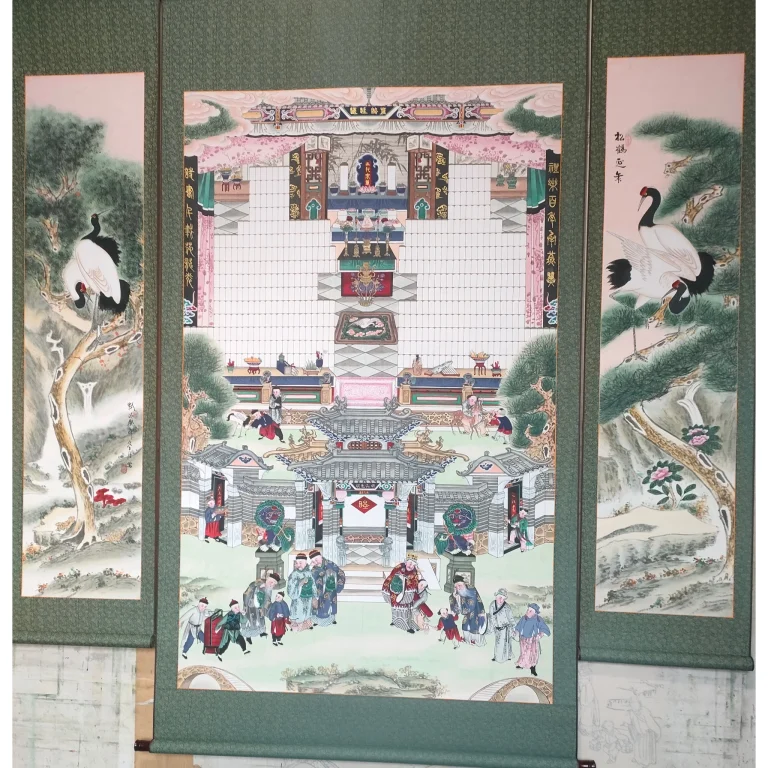
Beyond the objects in his hands, the animals frequently appearing in paintings of Shou Lao (God of Longevity) also carry deep meaning. The crane is the mount of immortals in legend, said to live for a thousand years, and represents nobility and long life; the spotted deer, whose name in Chinese sounds like “emolument” (*lu*), symbolises high official rank and good fortune. They often appear as Shou Lao’s mounts or companions, and together with the god himself, they complete the harmonious imagery of the “Three Stars” – Fortune, Emolument, and Longevity – shining high above.
—
Pine Tree: The Resilient Vitality Symbolized
The pine tree remains evergreen, tall and unyielding, retaining its vitality even in severe cold. In Shou Lao (God of Longevity) scroll paintings, the pine often serves as a background or foil, symbolising vigorous life and eternal youth. It is frequently combined with cranes and lingzhi to reinforce the motif of longevity and perseverance, implying that Shou Lao , like an ancient pine, stays green year after year and preserves his enduring spirit forever.
—
In summary, every object in a Shou Lao (God of Longevity) scroll painting is by no means arbitrary. Together, they form a complete system of auspicious symbols, carrying the Chinese people’s most sincere and beautiful wishes for health, longevity, wealth, honour, and the continuance of family lines.