
Gongfu tea is not a specific type of tea, but rather a highly refined brewing technique and tea ceremony. Originating from the Chaoshan and southern Fujian regions of China, it has since spread widely across the country and around the world. This practice imposes strict standards on tea wares, water quality, heat control, and brewing procedures. At its heart, Gongfu tea embodies the spirit of harmony, respect, precision, and joy.
This guide covers everything you need to know — from the origins and global spread of Gongfu tea, to the essential tea wares that make the ceremony complete, including the tea canister, chinese teapot, tea scoop, tea cup holder, and teapot stand.
The meaning of the term “Gongfu tea” has undergone a fascinating evolution throughout history.
Original Meaning: Premium Tea Leaves: During the Qing Dynasty, “Gongfu tea” originally referred to a premium oolong tea produced in the Wuyi Mountains of Fujian Province. Lu Tingcan, the magistrate of Chong’an County during the Qing Dynasty, clearly stated in his work Continuation of the Classic of Tea that among Wuyi rock teas, “the best are called ‘Gongfu tea’.” At that time, it was a mark of exceptional quality.
Evolution: From a Specific Tea to a Brewing Method: Over time, the meaning of “Gongfu tea” shifted. It gradually evolved from referring to a specific tea to describing the meticulous brewing method practiced in southern Fujian and the Chaoshan region of Guangdong, where small pots and tiny cups are used to steep oolong tea with great care. This is the Gongfu tea ceremony we know today.
The Nuance of “Gongfu” vs. “Kung Fu”: In the Minnan and Chaoshan dialects, “Gongfu” means meticulous, refined, and time-consuming work, while “Kung Fu” refers to skill and craftsmanship. Thus, “Gongfu tea” emphasizes the detailed process, whereas “Kung Fu tea” highlights the practitioner’s mastery. Both terms are widely used and each has its own valid basis.
The development of Authentic Chinese Gongfu Tea culture spans centuries of refinement before reaching the world stage.
Early Echoes (Song Dynasty): The roots of Gongfu tea can be traced back to the Song Dynasty. A cliff-side inscription from the Northern Song period in Chaozhou, Guangdong, bears the poetic line “tea stove and incense niche side by side,” confirming the long-standing tea-drinking customs in the region.
True Emergence (Late Ming to Early Qing): The Gongfu tea brewing method we recognize today is widely acknowledged to have emerged during the late Ming and early Qing dynasties. By the Qing Dynasty, Gongfu tea was already thriving in Zhangzhou, Quanzhou in Fujian, and Chaozhou in Guangdong. Yu Jiao, a Qing Dynasty scholar, recorded in his work Miscellaneous Notes from the Dream Factory: Customs of Chaojia one of the earliest written accounts: “The method of preparing Gongfu tea originates from Lu Yu’s Classic of Tea, yet the utensils are even more refined.”
The Golden Age (Qing Dynasty): In the late Qing and early Republic period, Weng Huidong, a native of Chaozhou, wrote Chaozhou Tea Classic: Gongfu Tea, systematically documenting the tea wares and procedures of Chaozhou Gongfu tea. This work marked the full maturity of the craft.
Global Spread: Gongfu tea not only took root in China but also spread worldwide through Chinese emigration. It reached Taiwan and the overseas Chinese communities of Southeast Asia, and even influenced Western tea culture, including the British afternoon tea tradition. In 2022, “Traditional Chinese tea processing techniques and associated social practices” were inscribed on the UNESCO Representative List of the Intangible Cultural Heritage of Humanity, with Chaozhou Gongfu tea as an important component.
The soul of a Authentic Chinese Gongfu Tea set lies in its core wares, which determine the brewing style and overall experience. Every piece, from the tea canister to the chinese teapot, plays its part.
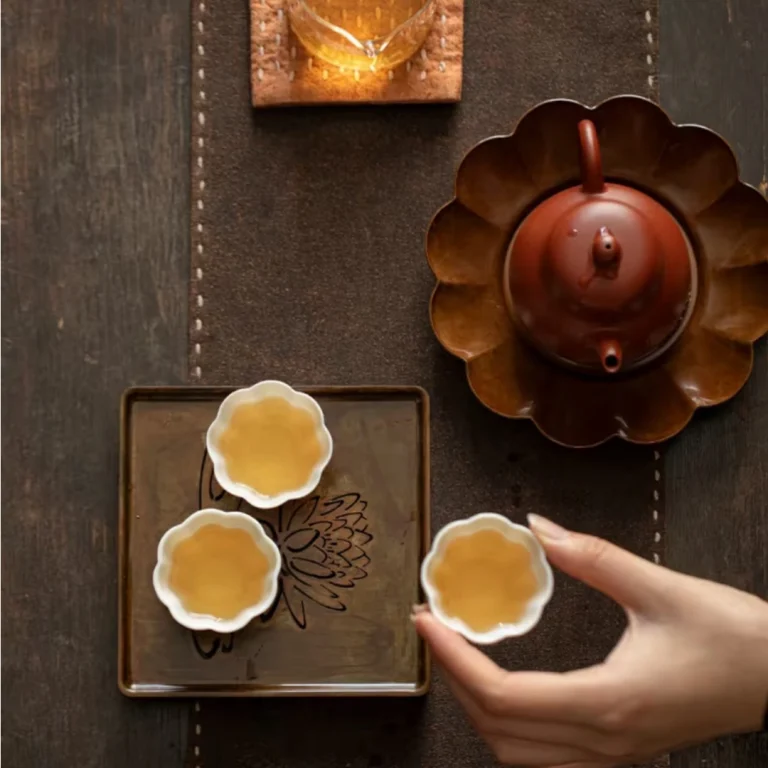
Teapot (Chinese Teapot): The centerpiece of Gongfu tea, commonly called the “punching pot” or “Su pot.” Chaozhou tea masters favor Yixing purple clay teapots, particularly the revered “Mengchen Pot.” A quality chinese teapot is essential for the perfect brew.
Covered Bowl (Gaiwan): Shaped like an inverted bell, it consists of a lid, bowl, and saucer — symbolizing heaven, earth, and humanity. It allows for quick pouring, easy removal of tea leaves, and does not absorb flavors.
Fairness Cup (Gongdao Bei): Used to hold the brewed tea before evenly distributing it to each cup, ensuring every guest experiences the same strength of tea.
Tea Cup: The vessel for drinking. It should be small, shallow, thin, and white. The celebrated “Ruochen Cup” is considered the gold standard.
Fragrance Cup: Specially designed for appreciating highly aromatic oolong teas. Its slender shape retains and concentrates the tea’s aroma.
These wares work silently behind the scenes to ensure a perfect brew.
Tea Scoop: Used to measure tea leaves from the canister, controlling the exact amount for each brew. The tea scoop has a long history — it was recorded in Lu Yu’s Classic of Tea: Four Utensils during the Tang Dynasty: “The scoop is for measuring, for standardizing, for gauging.” A chinese tea scoop made from bamboo, wood, or metal adds both function and aesthetic.
Tea Spoon (Tea Pick): Also known as a tea spoon scoop. It has two primary uses: first, to gently guide dry tea leaves from the tea scoop into the pot or gaiwan, avoiding direct hand contact for hygiene and elegance; second, to remove spent tea leaves after brewing, keeping the pot clean and protected. In the Gongfu tea procedure, the step “placing the fragrant tea into the palace” refers precisely to this action.
Tea Funnel: Placed over the pot opening to enlarge the surface area and prevent dry tea leaves from scattering during pouring. A proper tea tin canister keeps leaves fresh between uses.
Tea Holder: A versatile tool that combines the functions of the tea scoop and tea spoon, while also allowing for appreciating the dry tea’s shape and aroma. An airtight tea canister ensures the tea retains its full character until the moment of brewing.
Though subtle, these wares are indispensable for both function and ceremony.
Teapot Stand (Teapot Tray): Used to hold the teapot and catch any overflow water during brewing, protecting the table surface from moisture. The teapot stand or teapot tray rose to prominence with the “dry brewing method” popularized in the 1980s, and is essential when “rinsing the pot” during the Gongfu tea ceremony. A wooden teapot stand or bamboo teapot tray adds natural elegance.
Tea Cup Holder (Tea Saucer): Used to support the tea cup — a subtle detail of elegance on the tea table. Its history traces back to ancient “cup trays.” The tea cup holder or tea saucer serves three main purposes: protecting hands from heat when lifting hot tea, ensuring hygiene and grace when serving tea without touching the cup rim, and protecting surfaces from heat damage or water stains. A porcelain tea cup holder or ceramic tea cup holder pairs beautifully with traditional sets.
Tea Canister (Tea Storage): A tea canister or tea caddy is essential for preserving the freshness and aroma of tea leaves. A pewter tea caddy or chinese pewter tea canister offers an airtight seal, while a metal tea canister provides durability and protection. Whether you search for tea storage, tea tin canister, or canister for tea, the right vessel keeps your leaves at their best.
Among Gongfu tea wares, a classic ensemble known as the “Four Treasures of the Tea Room” deserves special mention:
Mengchen Pot — A small Yixing purple clay teapot, named after the Ming Dynasty master Hui Mengchen.
Ruochen Cup — A remarkably small white porcelain tea cup, often inscribed with the characters “Ruochen.”
Yushu Wei — A brownish thin-walled clay kettle used for boiling water.
Chaoshan Stove — A small red clay stove, traditionally used for heating water over charcoal.
The full tea set, including a quality chinese pewter tea set, elevates the ceremony to an art form. An airtight tea canister and tea canister complete the preparation, keeping every element fresh for the perfect brew.
Beyond the core items, the “Six Gentlemen of the Tea Ceremony” — a set of six tools including the tea scoop, tea spoon, tea tongs, tea needle, tea funnel, and tea holder — are often found on a traditional tea table, adding to the ritualistic beauty of the experience. A tea caddy tin or tin tea canister ensures long-term storage, while the tea caddy itself is an essential part of any serious tea collection.
The Gongfu tea ceremony has evolved from a regional custom to a globally recognized cultural treasure. In 2008, “Tea Art (Chaozhou Gongfu Tea Art)” was inscribed on China’s second batch of National Intangible Cultural Heritage list. In 2022, “Traditional Chinese tea processing techniques and associated social practices” — with Chaozhou Gongfu tea as a key component — were added to the UNESCO Representative List of the Intangible Cultural Heritage of Humanity.
Today, the Gongfu tea ceremony is practiced worldwide. It has become an important cultural bridge connecting Chinese communities across the globe — from the tea houses of Fujian and Guangdong to the international stage of cultural exchange. The essential tea wares — from the tea canister and chinese teapot to the tea scoop, tea cup holder, and teapot stand — remain the physical anchors of this enduring tradition.
An authentic Gongfu tea set is like a fully equipped “tea workshop.” Its value lies not in the complexity of its tools, but in the precise cooperation of each piece to deliver a perfect cup of tea. For those starting their journey, a basic set consisting of a chinese teapot, fairness cup, tea cups, kettle, and teapot stand is the ideal starting point. As your understanding of tea deepens, you can gradually add more specialized wares to enhance your experience.
From a type of tea to a way of life, from a local custom to a world-class cultural treasure, Gongfu tea represents not just a sophisticated brewing method, but the Chinese pursuit of quality in life and the spirit of harmony, respect, precision, and joy.