
China‘s Unique Pure Tin Carving Art · 350 Years of Imperial Craftsmanship
Laiwu Pewter Engraving is a traditional metal carving craft that uses pure tin as its raw material, originating in Laiwu District, Jinan City, Shandong Province. It is celebrated for its exquisite forms, elegant ornamentation, and meticulous craftsmanship, earning the praise: “Bright as silver, clear as mirror, resonant as a chime.”
The higher the purity of the tin, the purer its luster — after thousands of hammer strikes and polishing, 99.9% pure tin naturally reveals a shine as brilliant as silver and a finish as smooth as a mirror. When struck, pewter pieces produce a clear, resonant metallic ring, much like a chime.
Tin is the fourth precious metal after gold, silver, and copper. It is non-toxic, rust-proof, moisture-resistant, and resistant to acids and alkalis. Pewter ware has long been praised: “Water stays sweet, wine stays fragrant, tea retains its flavor, and flowers last longer in pewter vessels.” In 2008, Laiwu Pewter Engraving was inscribed on the second batch of China’s National Intangible Cultural Heritage list. Today, it continues to shine as a treasured lead free pewter art form.
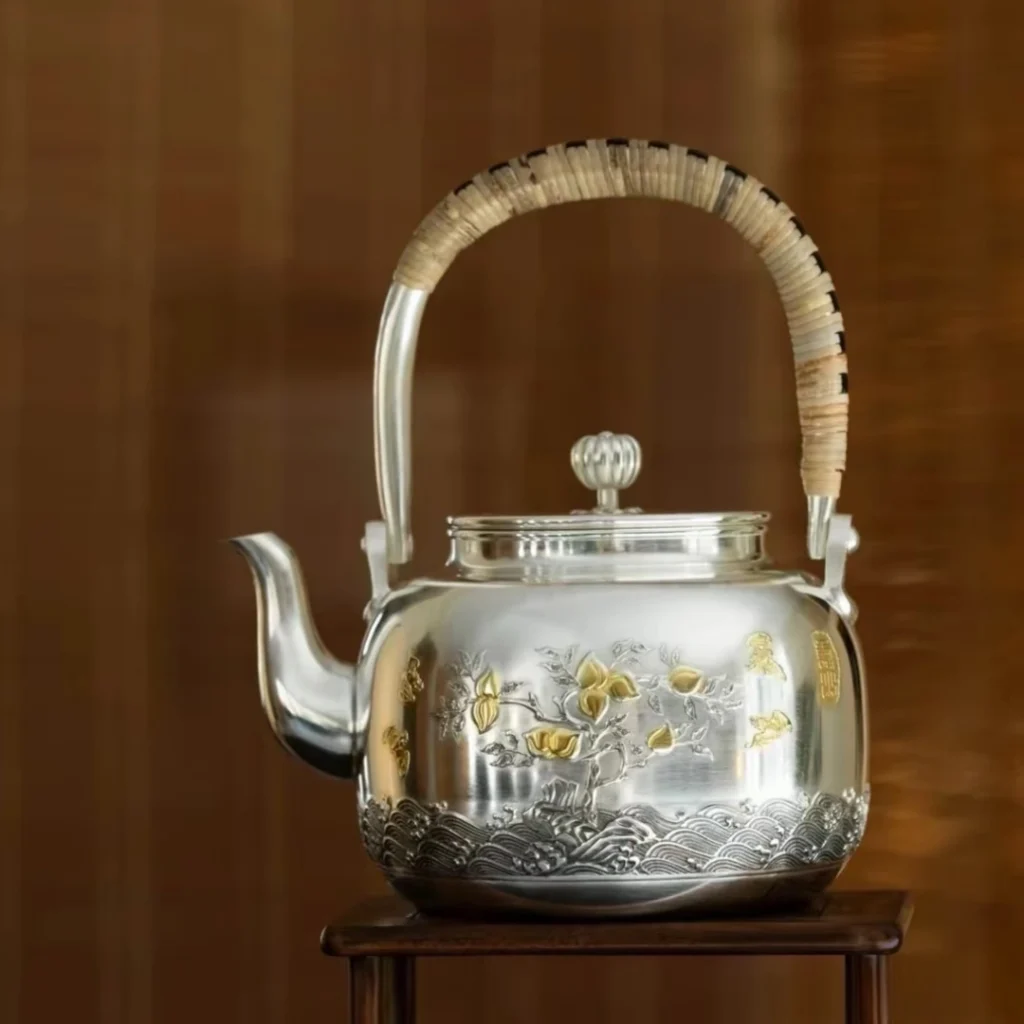
Laiwu Pewter Engraving products come in a wide variety — including ritual vessels, wine sets, tea sets, scholar‘s desk items, art sculptures, and metal figurines. With over 100 categories ranging from flowers, birds, fish, and insects to poetry, dragons, phoenixes, auspicious beasts, and legendary figures, there is something for every taste. Works can also be custom-made according to client specifications, offering both high artistic collection value and practical utility as exquisite pewter decor for the home or office, and a meaningful chinese lucky charm for any feng shui home decor setting.
The history of Laiwu Pewter Engraving traces back to the 15th year of the Kangxi reign of the Qing Dynasty (1676) . According to historical records, the Wang family pewter craft, founded by the first-generation master Wang Shixing, had already gained favor with the imperial court and was presented as tribute.
During the Qianlong reign of the Qing Dynasty, Laiwu‘s pewter art reached its zenith, with over a thousand craftsmen practicing the trade. Artisans were primarily concentrated in the western part of Laicheng, Yangzhuang, and Zhaili — with the Wang family of western Laicheng being the most renowned. Historical records state: “When the Qianlong Emperor’s daughter married into Qufu, artisans were dispatched from the capital to Laiwu for custom orders.” Some of the pewter wares now preserved in the Kong Family Mansion were commissioned for the emperor‘s daughter’s wedding.
Laiwu was an important metallurgical center during the Spring and Autumn and Warring States periods. Its abundant coal, copper, iron, and tin resources provided the foundation for pewter engraving techniques to endure for centuries.
In 2006, pewter engraving was inscribed on the first batch of the Shandong Provincial Intangible Cultural Heritage list. In 2008, it was elevated to the second batch of China‘s National Intangible Cultural Heritage list. In 2018, “Feng Wang Xiang” pewter engraving was recognized as a “Time-Honored Brand of Shandong” .
Laiwu Pewter Engraving uses 99.9% pure tin as its raw material, with no other metals added — preserving the green-metal properties of pure tin. The creation process involves twelve core steps:
| Step | Description |
|---|---|
| Design | Create three-dimensional drawings based on the malleability of tin |
| Melting | Melt tin ingots into liquid form |
| Sheet Casting | Pour liquid tin into molds and cool into solid sheets |
| Cutting | Trace and cut patterns onto tin sheets |
| Blank Shaping | Hammer cut tin sheets into rough vessel forms |
| Forming | Further refine the shape of the vessel |
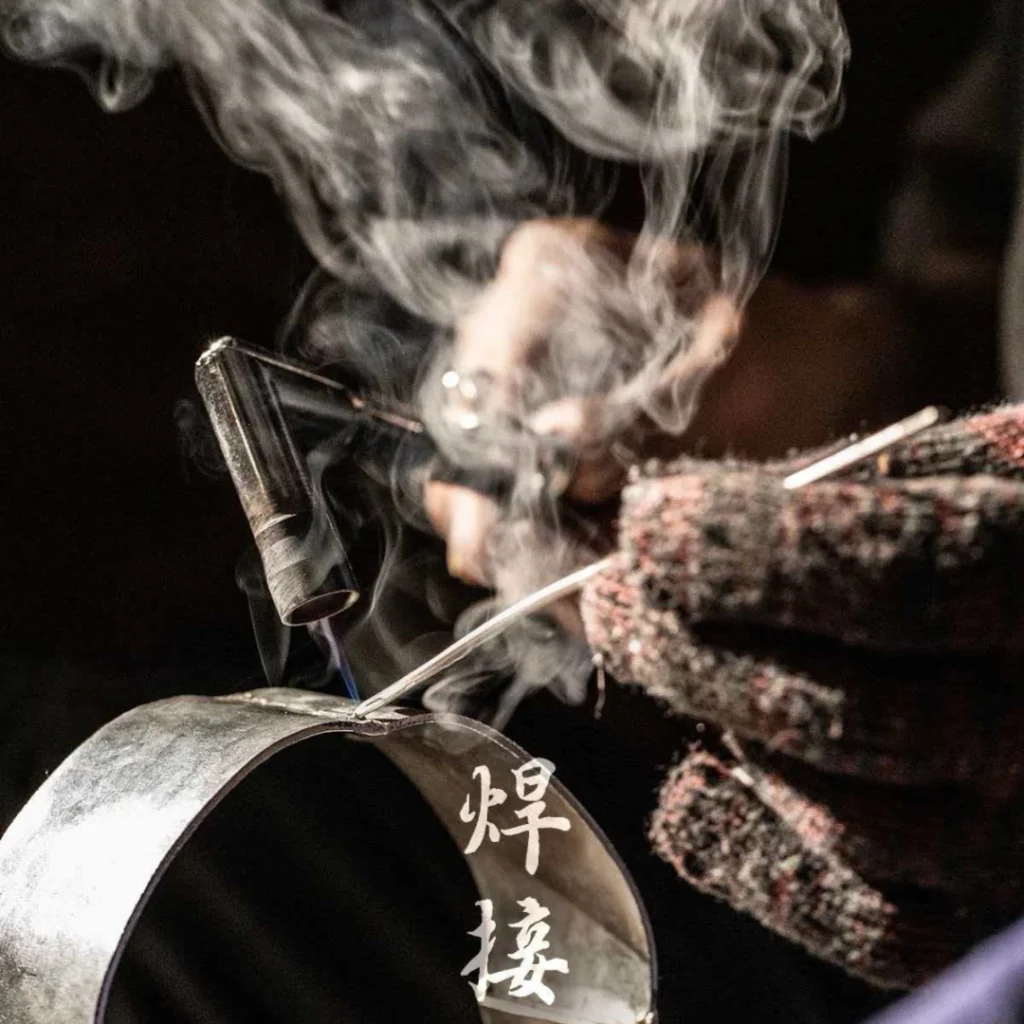
| Soldering | Use rosin-alcohol flux and flame to melt tin strips and seal joints |
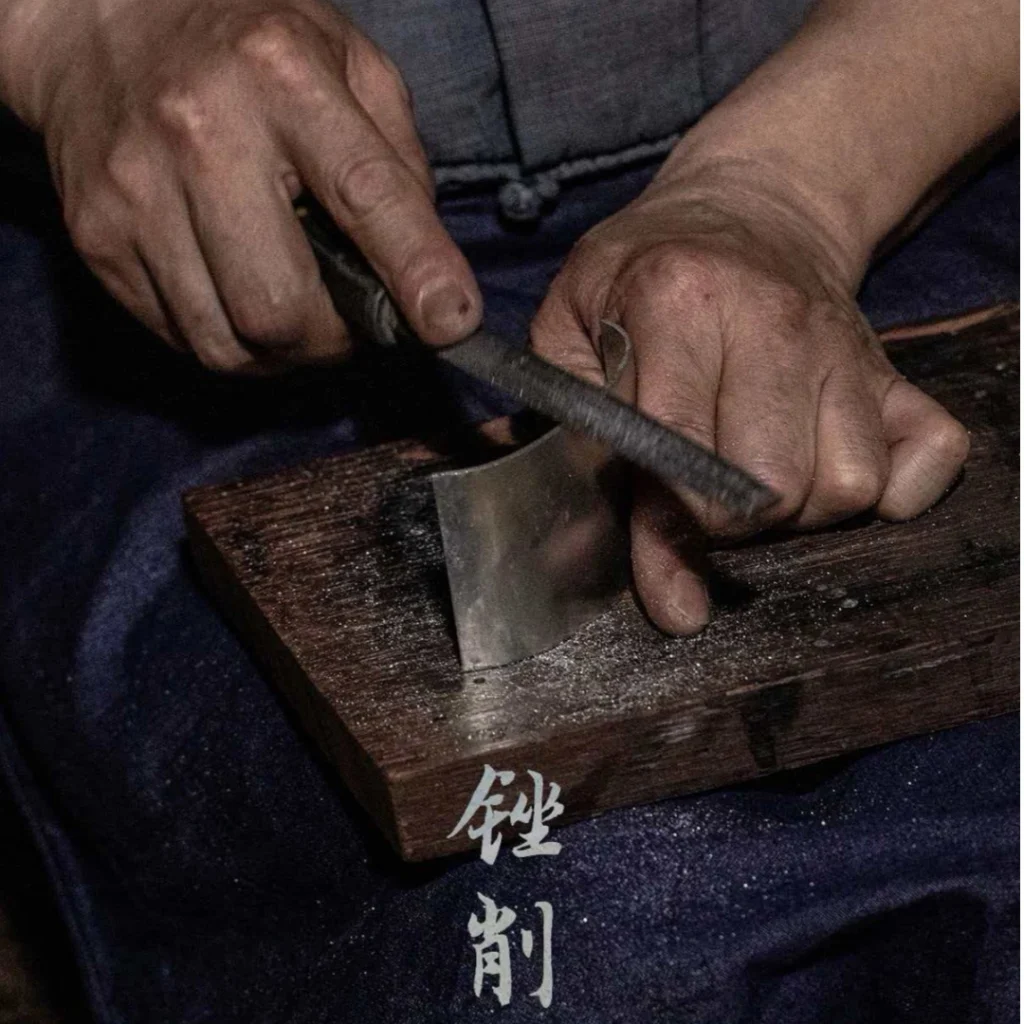
| Filing & Grinding | Smooth and trim the edges and surfaces |
| Burnishing | Polish the surface to a smooth finish |
| Engraving | Decorate using chiseling, modeling, carving, and soldering techniques |
| Fine Polishing | Bring out a pearlescent luster |
Twelve major steps — each broken down into numerous sub-steps. A single sheet of tin, from melting to finished piece, undergoes hundreds of measurements, thousands of polishing strokes, and tens of thousands of hammer strikes — before finally revealing the silver gleam in your hands as a stunning pewter figurine or lead free pewter decor piece.
A large-scale pewter engraving work, from concept to completion, requires approximately two to three months and at least tens of thousands of hammer strikes — a true labor of love that results in a one-of-a-kind pewter decor treasure, perfect as a chinese lucky charm or a sophisticated chinese decorations home accent.
Laiwu Pewter Engraving techniques draw from wood carving and stone carving traditions, while also incorporating the unique properties of metal — notably, it has developed “pull soldering” and “build-up soldering” as distinctive metal engraving methods. In shaping forms, artists can both add and subtract material, employing both shallow and deep relief to create works that are fluid and vibrant.
Laiwu Pewter Engraving is most prominently represented by the Wang family craft, founded by Wang Shixing. The tradition has been passed down through nine generations and has endured 350 years of history.
Throughout its long development, successive generations of inheritors have worked tirelessly to innovate, refine tools, and perfect techniques — continuously elevating the art of Laiwu Pewter Engraving.
| Generation | Master | Contribution |
|---|---|---|
| 1st Generation | Wang Shixing | Founded the first pewter workshop in 1675, establishing the Wang family legacy |
| 3rd Generation | Wang Yepu | Created pewter wedding trousseau for the Qianlong Emperor‘s daughter — pewter ware now preserved in the Kong Family Mansion |
| 5th Generation | Wang Junting | Won the Silver Medal at the 1915 Panama-Pacific International Exposition |
| 7th Generation | Wang Lei | Dedicated guardian of ancient techniques, the patriarch of Laiwu pewter engraving, still practicing at age 87 |
| 8th Generation | Wang Shengliang | National-level Intangible Cultural Heritage representative inheritor, with over 40 years in the craft |
| 8th Generation | Wang Qianjun | Broke family tradition to train apprentices, driving transformation toward cultural and creative industries |
| 9th Generation | Wang Feiyue | Innovates by fusing pewter with cloisonné and other materials, bringing the heritage to the world stage |
The eighth-generation master, Wang Shengliang, adheres to the family motto: “Pass on with integrity, transmit with heart, honor the spirit of the vessel, honor the meaning of the vessel.” He has preserved the core traditional techniques — forging, chiseling, modeling, carving, soldering, and polishing — in their purest form. He insists on pure handcrafting, saying: “Because the handcrafted feel and texture are simply different.”
Today, Laiwu Pewter Engraving continues in the hands of the ninth-generation Wang family inheritor, Wang Feiyue. She innovates by fusing pewter with cloisonné and other materials, carrying this 350-year-old craft into the world with a fresh new expression. Whether as traditional wine and tea vessels or contemporary art sculptures, every piece carries forward the family motto: “Pass on with integrity, transmit with heart.” Whether you are looking for a refined pewter figurine or a statement pewter decor piece, each work is a unique collectible. These pieces also serve as thoughtful chinese lucky charm gifts for weddings, anniversaries, or any occasion that calls for chinese decorations home that tell a story.
With its outstanding artistic value, Laiwu Pewter Engraving has shone on both domestic and international stages:
| Year | Honor |
|---|---|
| 1915 | Works by 5th-generation inheritor Wang Junting won the Silver Medal at the Panama-Pacific International Exposition |
| 2006 | Inscribed on the first batch of Shandong Provincial Intangible Cultural Heritage list |
| 2008 | Inscribed on the second batch of China‘s National Intangible Cultural Heritage list |
| 2010 | Works exhibited at the Shanghai World Expo |
| 2018 | “Feng Wang Xiang” pewter recognized as a “Time-Honored Brand of Shandong” |
| 2023 | “The Great Beauty of Jinan” Ruyi series won the Design Innovation Award at the “Lotus Cup” Shandong Arts & Crafts Design Innovation Competition |
| 2023 | “Embracing One” won the Gold Award at the “Shandong Handmade” Excellence Exhibition |
| 2025 | Exhibited at the Maritime Silk Road Intangible Cultural Heritage Exhibition |
Handcrafted Laiwu Pewter Engraving in standard classic styles — ready for you to own.
| Item | Details |
|---|---|
| Product Types | Laiwu Pewter Engraving home decor (pewter decor, tea sets, wine sets, scholar‘s desk items, and more) |
| Delivery Timeline | 60 days after order confirmation |
| Pricing | Fixed pricing — transparent and clear |
| Customization | Choose from existing patterns and standard sizes |
| CTA | 【Shop Now】→ Link to product page |
Tailor-made to your exact dimensions, design, and functional requirements — one-on-one in-depth consultation.
| Item | Details |
|---|---|
| Product Types | Premium Laiwu Pewter Engraving customization (any vessel form, any subject matter) |
| Delivery Timeline | Depends on technical solution complexity — typically 2-3 months |
| Pricing | Inquiry-based — customized quotation |
| Customization | Fully bespoke — no limits |
| CTA | 【Inquire Now】→ Link to contact page |
Have questions about our Laiwu Pewter Engraving artworks? We‘re here to help.
| Channel | Contact |
|---|---|
| sales@heritcus.com | |
| +86 1379280546 | |
| +86 1379280546 |