
Chinese folk art paintings are far richer than just “a picture.” They encompass vast landscapes, the refined elegance of the Four Gentlemen (plum, orchid, bamboo, chrysanthemum), the prosperity of the God of Wealth, the blessings of the God of Longevity, the warmth of *Sisters‑in‑law Chatting*, and the abundance of *Abundance Year after Year*. Each work carries its own character and symbolism. That is precisely why *how* to hang it, *where* to place it, and *when* to display it become matters worth exploring. Get it right, and the painting comes alive; the days themselves take on a deeper flavor.
The first question in hanging a scroll is not where to put it, but what time of year it is.
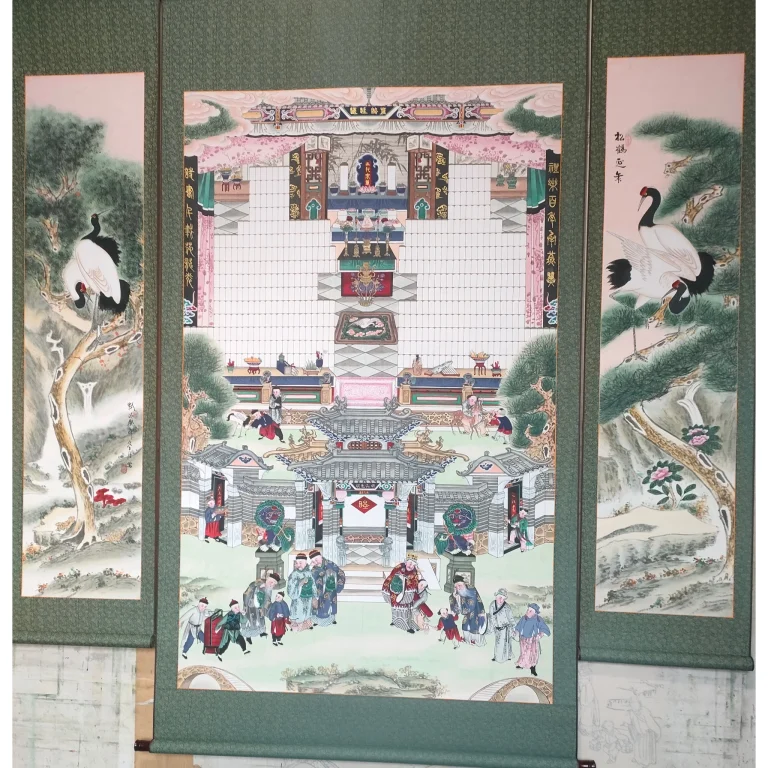
New Year’s Eve is the most solemn moment for hanging scrolls. The **ancestral tablet** – a scroll that records the names of generations of forebears – must be hung in the late afternoon or early evening of New Year’s Eve, as a ritual of “inviting” the ancestors home to celebrate the new year together. It is placed on the north wall of the main hall, with an offering table below, complete with incense, candles, and a bountiful spread of food. After the Lantern Festival (the 15th day of the new year), it is carefully taken down and stored.
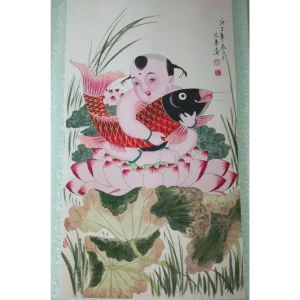
Also during the Spring Festival, **Abundance Year after Year** comes into its own. A chubby boy holding a big red carp, paired with lotus flowers – the lotus (*lián*) sounds like “successive” and the fish (*yú*) sounds like “surplus” – expresses the wish for a year of plenty. Hung in the center of the main hall or on the inner door, it brings a vibrant, joyful energy to the home.
The **God of Wealth** also makes his appearance at this time, especially in shops and businesses, where he is placed in a propitious corner to pray for prosperity and good fortune.
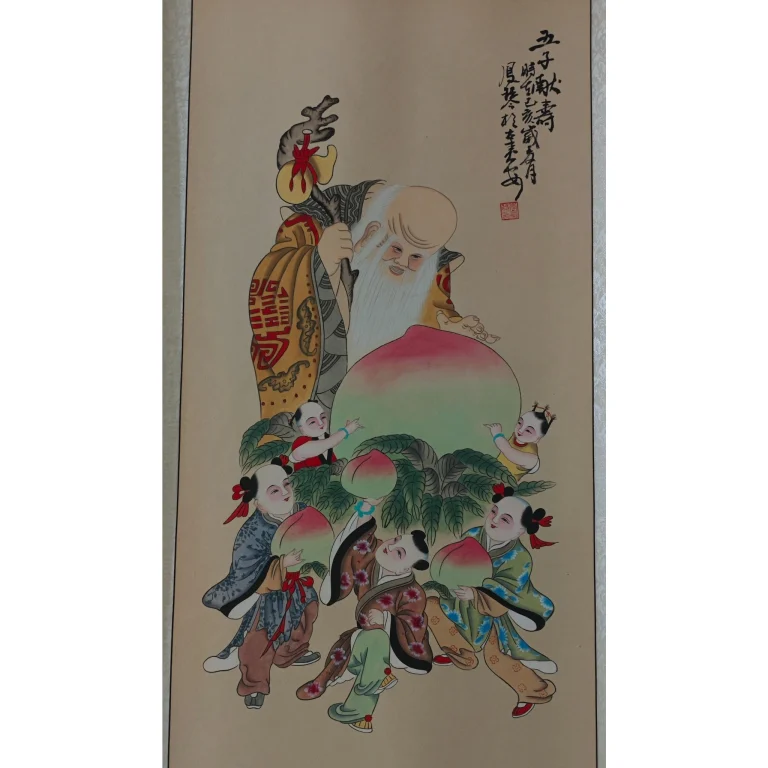
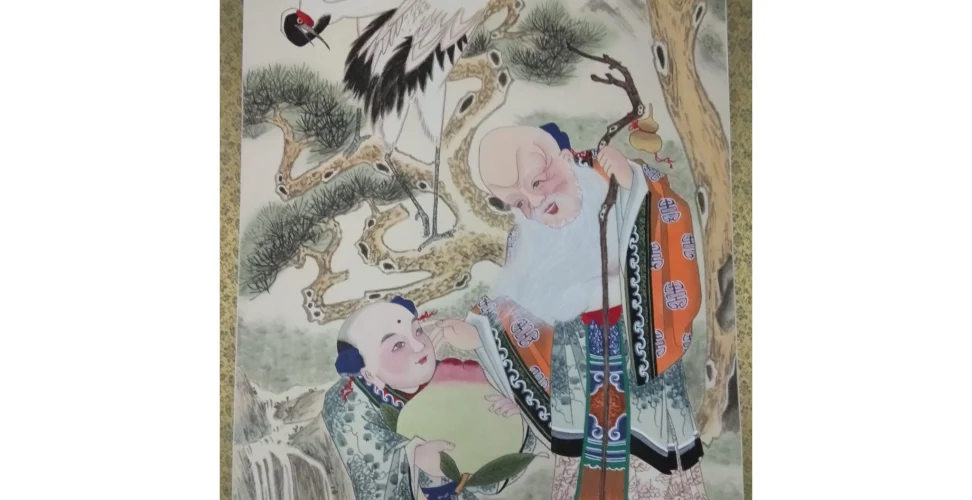
Other scrolls are not tied to a particular season, but to sentiment. The **God of Longevity** is often brought out for an elder’s birthday,
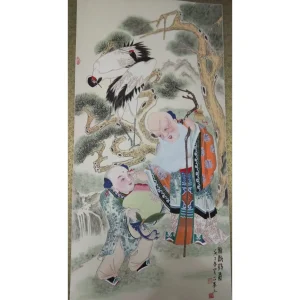
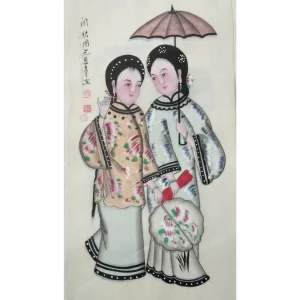
but many families keep it hanging year‑round in the elder’s room as a wish for lasting health. **Sisters‑in‑law Chatting**, a tender scene of a young wife and her husband’s sister in intimate conversation – without lectures or moralizing – finds its natural home in a young woman’s private chamber, silently conveying the simple truth that “harmony in the family brings prosperity.”
Different subjects have different temperaments, and they need to be placed accordingly.
**Landscapes** and the **Four Gentlemen** are refined and tranquil, so they belong in studies and sitting rooms. A landscape expands the mind; bamboo teaches integrity; plum blossoms inspire resilience – they do not shout, but gently impart their lessons.
**Opera scenes** and **legendary tales** are lively and full of folk charm, perfect for the living room. When guests arrive, no explanation is needed – the painting tells its own story.
Pastoral themes like **farming, woodcutting, fishing, and reading** fit anywhere, because they speak of the life everyone dreams of – working the fields in fair weather, reading in the rain, fishing at leisure, gathering firewood on the hills – simple yet deeply satisfying.
There is one subtle rule that many observe: in a landscape, the direction of flowing water matters. Streams and waterfalls should ideally flow *into* the house, symbolizing that positive energy gathers within. If they flow toward the door or window, the ancients believed that “wealth escapes” and the mind becomes restless. As for the distant mountains, they should appear stable and substantial – if hung behind a seat, they imply “having a solid backing,” making one feel grounded and secure.
This is not superstition; it is a psychological comfort we all need in our living spaces, like an umbrella on a rainy day.
A hanging scroll suspended alone on a bare wall can feel a little thin. Placing a long narrow table, a pot of sweet flag, an ornamental stone, or even just a warm lamp beneath it creates a triad of “painting – furniture – object.” The painting is ethereal, the objects are solid, and between them the space gains depth.
This is the wisdom of traditional Chinese interior arrangement – not clutter, but dialogue. Beneath a picture of the God of Longevity, for instance, a small bonsai pine would give tangible form to the wish for “longevity as firm as a pine.”
The most delightful thing about scrolls is that they are alive. Unlike nailed‑down decorative prints, scrolls can be rolled up and replaced. As the old saying goes, “a scroll should not hang for more than thirty days.” Not because it cannot endure, but to give it rest and to let the space change with the seasons.
In spring, hang flowers and birds; in summer, pure lotus; in autumn, landscapes; in winter, snowy scenes – this is the refined scholar’s pleasure. In folk tradition, it is simpler: the God of Wealth and Abundance Year after Year at New Year; landscapes and the Four Gentlemen in ordinary times; the God of Longevity in the elders’ room; and occasionally Sisters‑in‑law Chatting in a young woman’s chamber. One scroll replaces another, and the year passes gently by.
Sunlight, dampness, and dryness are far more harmful than a nail. Keep scrolls away from direct sunlight near windows; be especially careful during the rainy season in the south; and in northern rooms with heating, keep them away from radiators. A fine painting deserves gentle care.
But in the end, when you hang a scroll, you are not just hanging paper and ink – you are hanging a piece of yourself. Choose a weekend, bring out the scroll you treasure, find the wall that suits it best – the ancestral tablet in the main hall, the Four Gentlemen in the study, the God of Longevity in the elder’s room, the sisters‑in‑law in the young woman’s chamber.
Unroll it gently – not just “hang” it, but “invite” it up.
Then step back two paces and look. It will tell you: when it is hung right, the days are right.