
$650.00
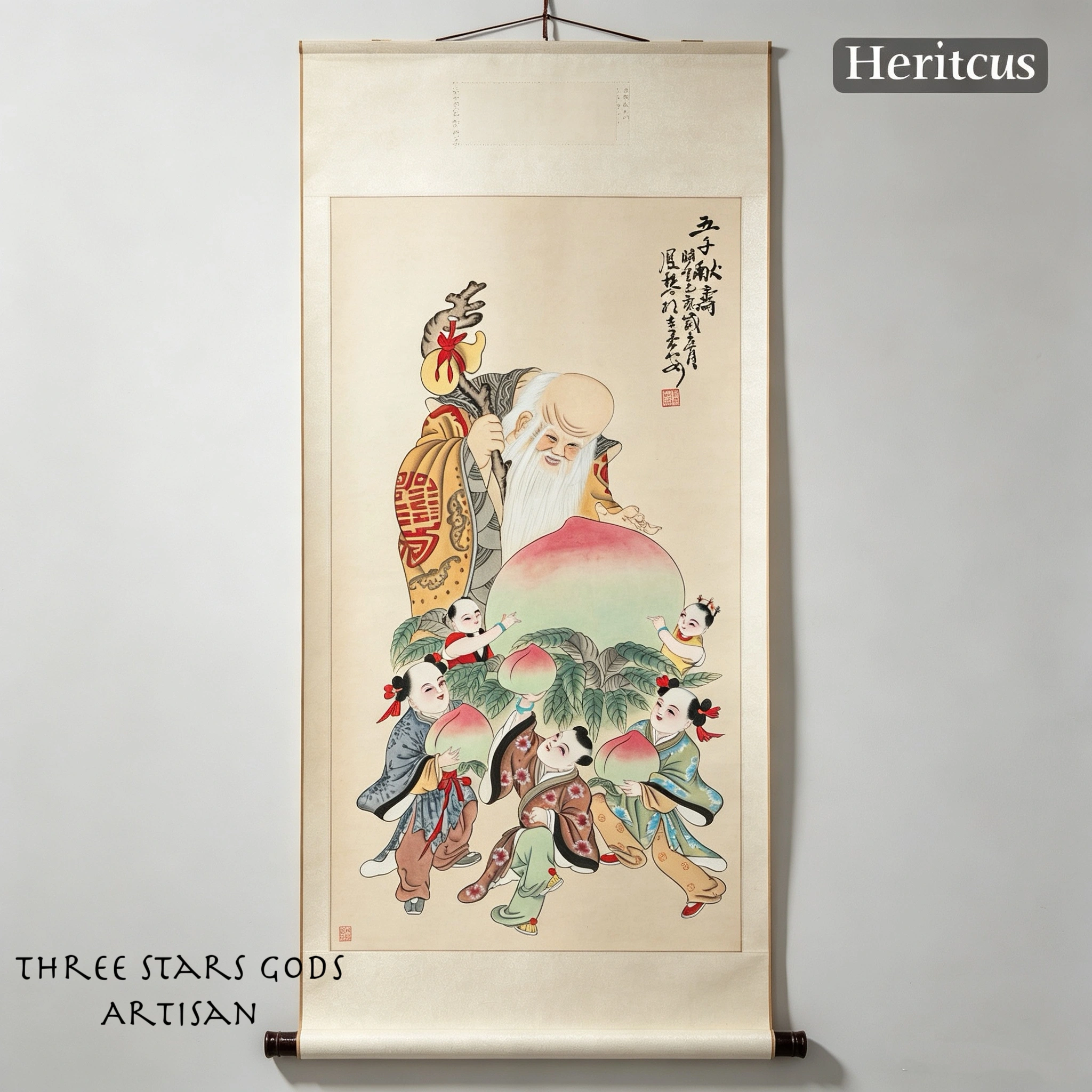
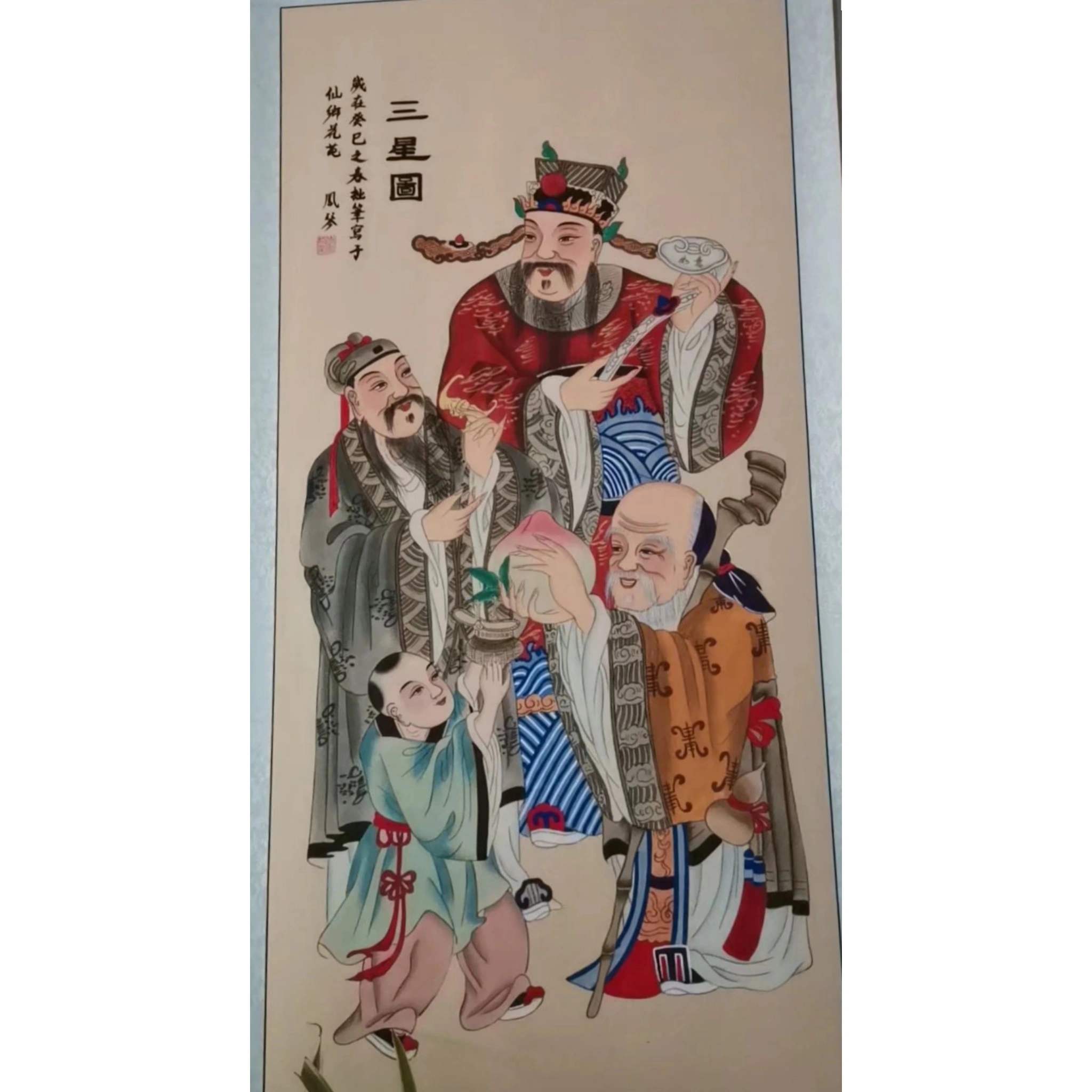
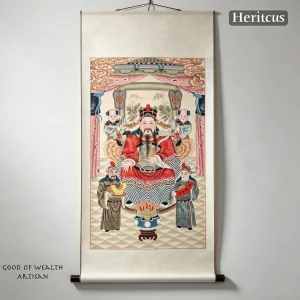
Shou lao ! a Chinese scroll painting handcrafted with the unique ash-rubbing technique from Gaomi, Shandong. Folk Artist Levels!Featuring God of Longevity, this painting symbolizes health, long life, and family blessings. Mounted on rice paper and silk brocade. 180cm × 70cm. A powerful Chinese lucky charm for any living room.
This Chinese scroll feng shui painting features Shou lao God of Longevity — one of the most revered deities in Chinese folk religion, symbolizing health, long life, and familial blessings. Folk Artist Levels Artisans handcraft it using the unique ash-rubbing technique from Gaomi, Shandong. This craft originated in the Ming Dynasty (1465-1487) and survives nowhere else in China. In 2006, Gaomi ash-rubbing New Year painting was inscribed on the first National List of Intangible Cultural Heritage of China. The piece comes mounted on traditional rice paper and silk brocade, making it a refined scroll painting for any wall.
“Shou Lao” and “Shou Xing” actually refer to the same deity, the Immortal of the South Pole, who governs human lifespan in Taoism and folk belief. Their distinction mainly stems from the evolution of appellations for the same deity in different historical contexts.
The term “Shou Xing” is the oldest, originating from the ancient star worship of the “Star of the Old Man of the South Pole” (Canopus). As early as the Zhou Dynasty, there were established rituals for sacrificing to this star. During the Han Dynasty, court astronomers regarded its appearance as an auspicious omen of peace under heaven, a view recorded by Sima Qian in the Records of the Grand Historian. By the Tang Dynasty, this star was formally personified as the “Old Man of the South Pole” and became the “Shou Xing” in the Taoist pantheon, together with the gods of Fortune (Fu Xing) and Prosperity (Lu Xing) forming the “Three Star Gods” (Sanxing), representing blessings, rank, and longevity for a fulfilled life. In the Song Dynasty, the worship of Shou Xing further integrated into Taoist theology and became a widely venerated auspicious deity among the people.
On the other hand, “Shou Lao” is a colloquial term that emerged during the dissemination of this deity among the common people. After the Ming Dynasty, the official sacrificial rites to Shou Xing were abolished, and the worship of Shou Xing thus completely moved from the state altar into everyday life. People no longer used the formal term “Shou Xing” but instead adopted endearing appellations like “Shou Lao,” “Old Shou Xing,” and “Shou Xing Lao’er,” expressing a sense of intimacy toward this deity as if he were an elder in the family.
Therefore, “Shou Xing” is the formal title used in Taoist scriptures and official sacrifices, while “Shou Lao” is the colloquial folk name. Though the names differ, they refer to the same divine being, jointly carrying the Chinese people’s enduring wish for health and longevity.
Folk paintings on the theme of Shou Lao and the Three Star Gods (Fortune, Prosperity, and Longevity) are an important part of traditional Chinese New Year pictures and birthday celebration culture. Such works are mostly produced by folk artists from the Weifang area in Shandong Province, using the local Puhui (ash‑rubbing) technique on Xuan paper scrolls, with a distinctive style passed down through generations. All works of this genre are completely hand‑painted; each piece embodies the artisan’s skill and dedication. Even though the Puhui technique allows for a degree of reproduction, the final coloring, outlining, and detailed rendering are all done by hand, ensuring that every work is unique and carries the warmth of human craftsmanship.
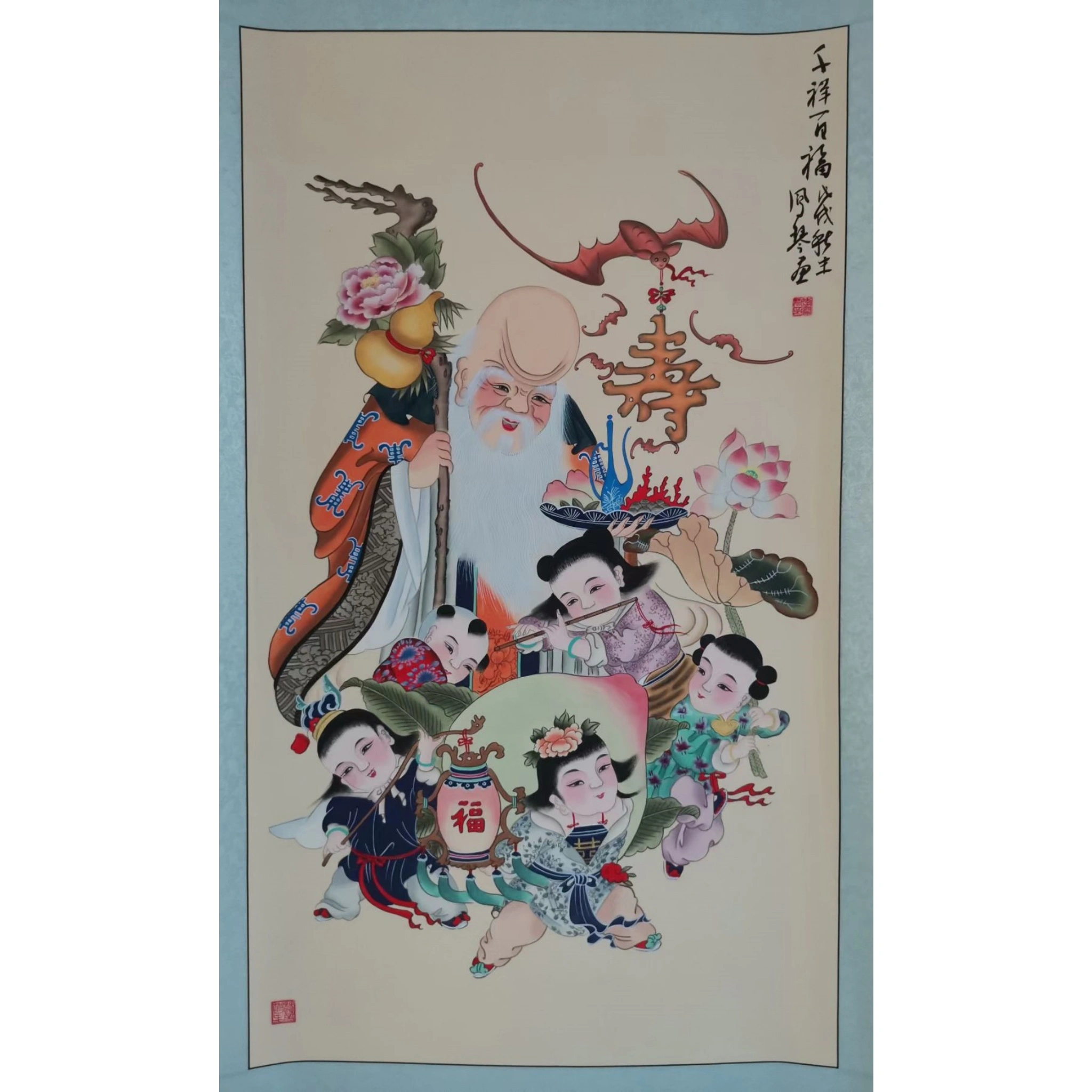
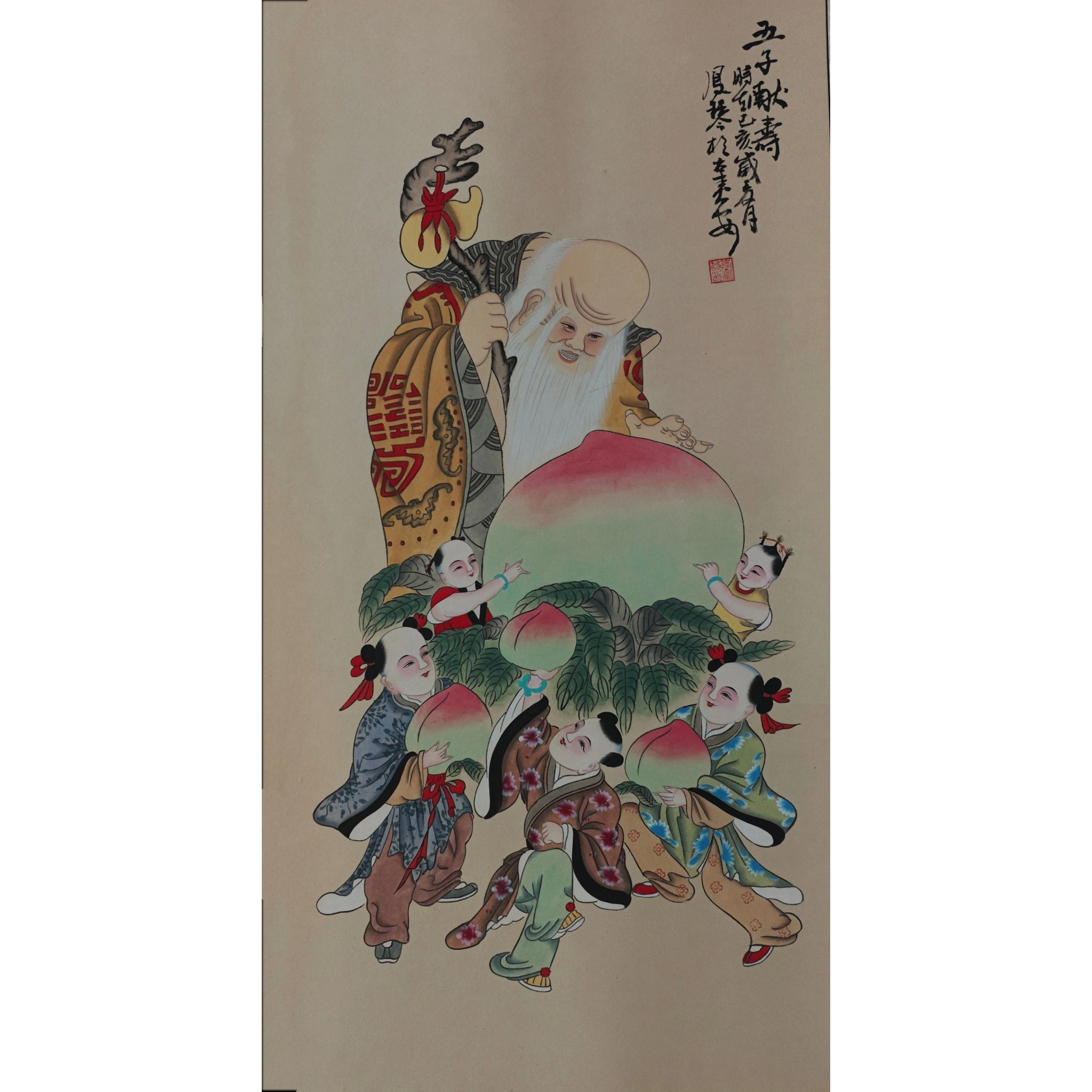
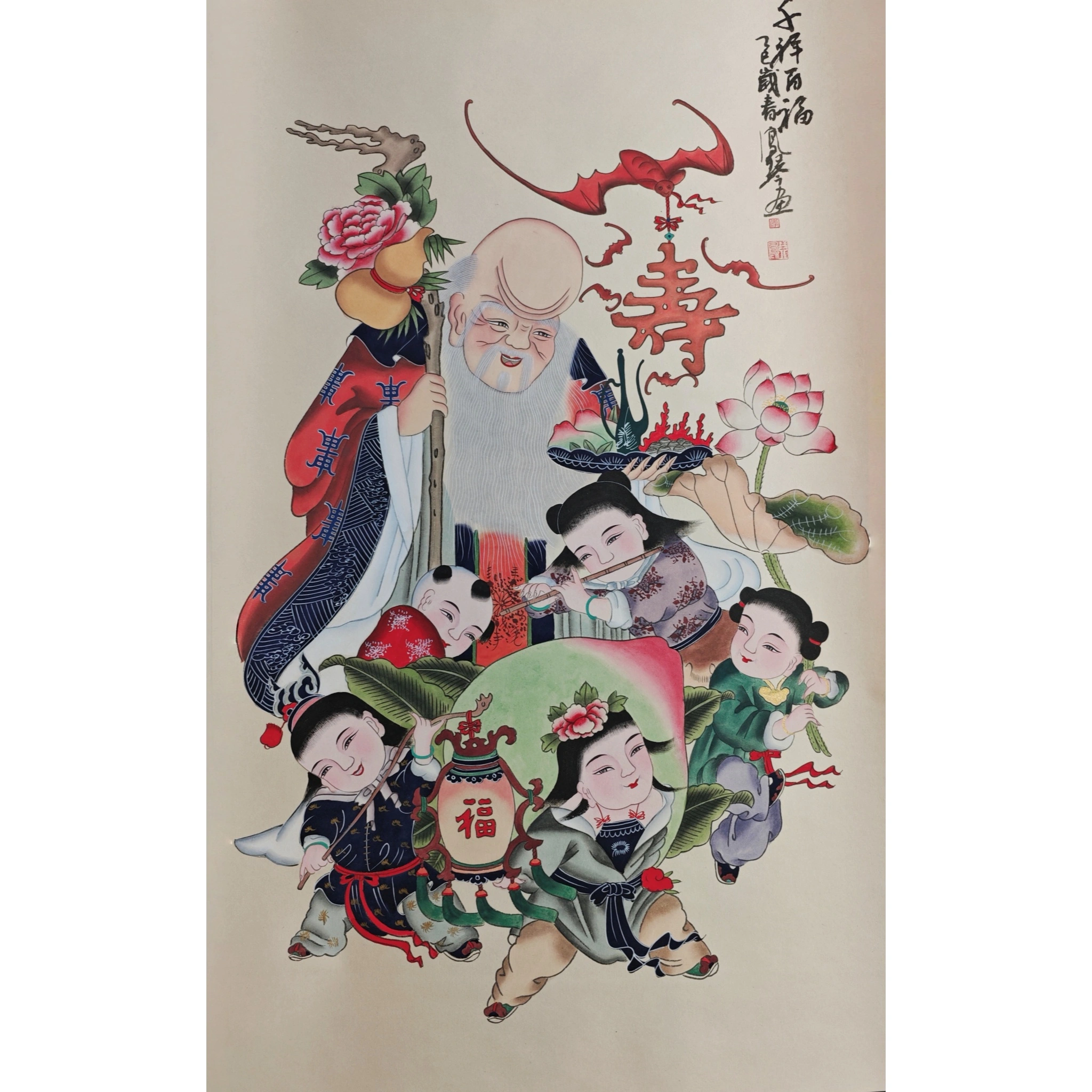
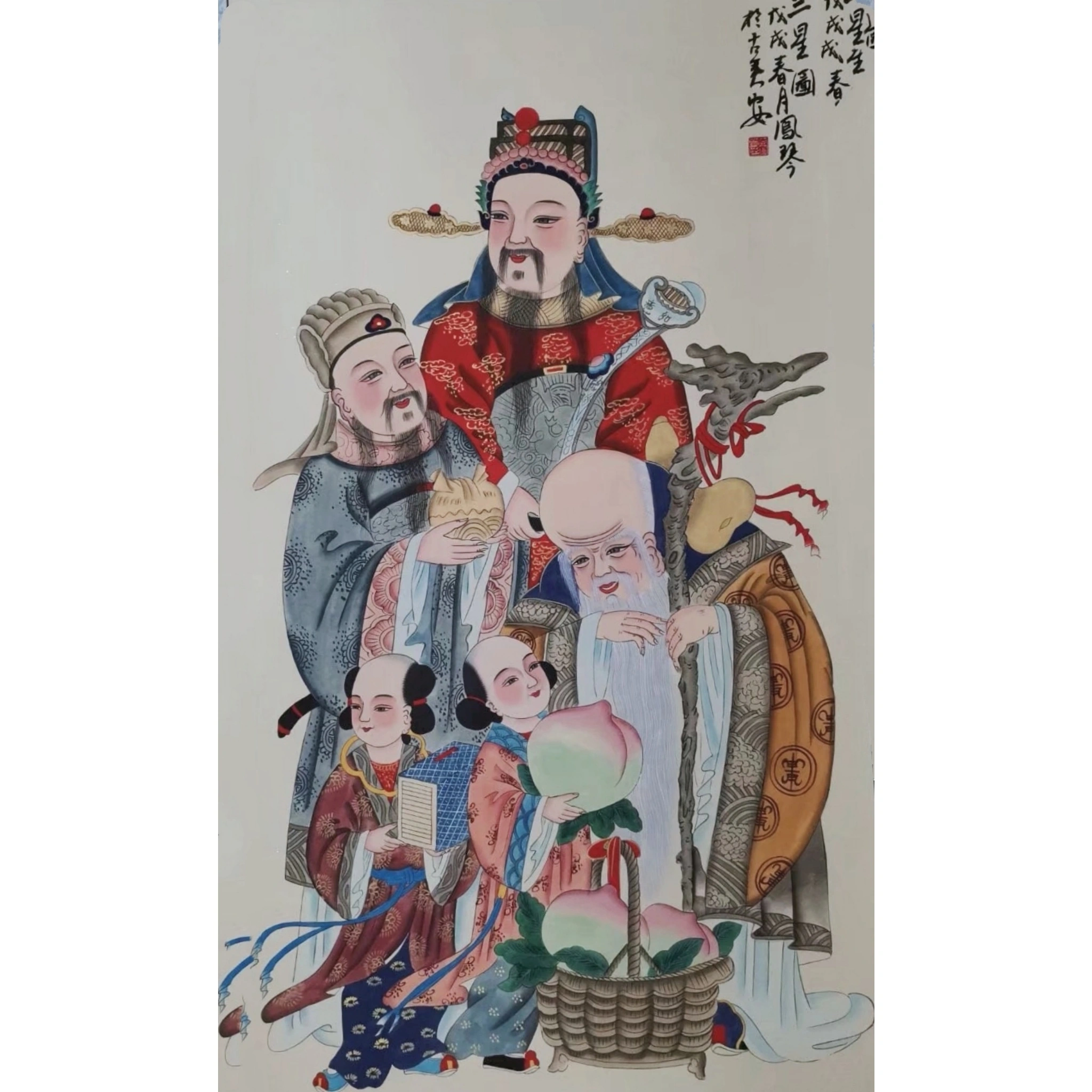
The Shou Lao (God of Longevity) paintings in Gaomi Puhui New Year paintings follow a set of established classic compositions, carrying people’s simple wishes for longevity, health, and complete blessings. The composition usually centers on the old God of Longevity: with a prominent forehead, white beard and eyebrows, kindly eyes and benevolent features, a complexion like peach blossom, holding a dragon-head cane and a plump longevity peach, either standing on auspicious clouds or riding a celestial deer. He is often accompanied by ancient pines and cranes, as well as attendant boys and maidens holding longevity peaches, creating a full and dignified composition. On both sides of the painting, couplets such as “May your longevity be as enduring as the pine on the Southern Mountain; may your blessings flow as endlessly as the Eastern Sea” are often added. Some works also write a large character “Shou” (longevity) directly in the picture, making the birthday theme even more striking. These works are mainly aimed at elderly consumers and are often used for birthday celebrations, festivals, and hanging in the main hall, with the primary purpose of blessing and offering birthday wishes. Representative works include Birthday Celebration Painting, Hundred Longevity Painting, Three Stars Painting, Fortune, Longevity, and Abundance, and Lion Boy Offering Longevity. To paint Shou Lao requires more than twenty intricate steps, including opening the eyes and eyebrows, powdering the face, outlining the face, smoking the face, rinsing the face, dotting the lips red, and combing the hair. The style carries folk freehand characteristics: bold and uninhibited lines, yet meticulous in delicate details, which makes the figure’s expression especially vivid. In terms of color, artisans follow northern aesthetics to give the old God of Longevity a slightly reddish complexion like peach blossom — “white hair and a youthful face.” Early works were mainly in ink and wash; after the Daoguang reign of the Qing Dynasty, color gradually replaced ink, becoming increasingly vivid. With strong color contrasts and frequent use of gold, the images are bright and eye-catching, deeply loved by the people.
In the compositions, the three deities—Fu Xing (God of Fortune), Lu Xing (God of Prosperity), and Shou Lao (God of Longevity)—appear together, full of vitality and expression. Shou Lao is often placed in the center to signify his prominence, with a high forehead, a long beard, and a smiling face, holding a magical peach and a deer‑headed staff, often accompanied by auspicious symbols such as cranes, lingzhi mushrooms, and gourds. Fu Xing holds a ruyi scepter or a child, symbolizing the arrival of good fortune. Lu Xing carries a ceremonial tablet or wears an official’s hat, representing promotion and rank. Together, they form the classic scene of “Three Stars Shining Bright,” conveying the wish for fortune, rank, and longevity to come together.
In terms of artistic expression, these paintings are particularly rich and vibrant in color, often employing striking contrasts of red, gold, green, and blue, which create a strong visual impact. The artisans outline the figures with bold, powerful lines and apply thick, saturated blocks of color, resulting in a style that is both rustic and refined, lively and auspicious. The ritual objects and symbolic attributes of Shou Lao are clearly depicted, full of distinctive Chinese folk characteristics. This use of color and composition not only suits the festive atmosphere of folk celebrations but also reflects the traditional Chinese aesthetic values that favor completeness, prosperity, and brightness.
Historically, such paintings were an indispensable festive decoration for the affluent classes in China during important occasions such as birthday celebrations, festivals, house‑warming, and New Year. They served not only as symbols of the host’s status and wealth but also as expressions of the family’s deep hopes for a better life. Hanging a picture of the Three Stars in the main hall signified that fortune, rank, and longevity had arrived at the doorstep, bringing peace and abundance to the household.
To this day, folk paintings on the theme of Shou Lao and the Three Star Gods continue to hold an important place in traditional festivities. They are not merely an art form but also a cultural memory deeply rooted in the people, perpetuating the Chinese people’s enduring, simple faith in and pursuit of a happy life over the centuries.
In Chinese culture, Shou lao God of Longevity is widely worshipped as a deity who brings health and long life. As a Chinese lucky charm, this painting is especially meaningful for the living room, where it is believed to attract blessings of health and longevity for the entire household. In feng shui decorating, placing a Shouxing painting in the living room or on the main wall of the home is thought to invite longevity and positive energy. It serves as a powerful symbol of health, happiness, and lasting blessings for the family.
This Shou lao God of Longevity painting belongs to our Crafted Collection. Skilled artisans create each piece, carrying forward this centuries-old tradition. Every piece maintains high quality standards while remaining accessible in both price and production time.
100% handmade — artisans draw and color by hand using a 500-year-old technique
Unique craft — this art form survives only in Gaomi, Shandong
Shou lao motif — symbolizes health, longevity, and family blessings
Chinese lucky charm — brings blessings of health and long life
Generous size — 180cm × 70cm,
Ready to display — mounted on rice paper and silk brocade
Each piece is made by hand. Please allow 2-3 days for dispatch. For out-of-stock items, production takes approximately 60 days. We will keep you updated on the progress. Custom orders are welcome — contact us for a quote. For full details, please refer to our Ordering & Delivery Policy below.
Reviews
There are no reviews yet.