
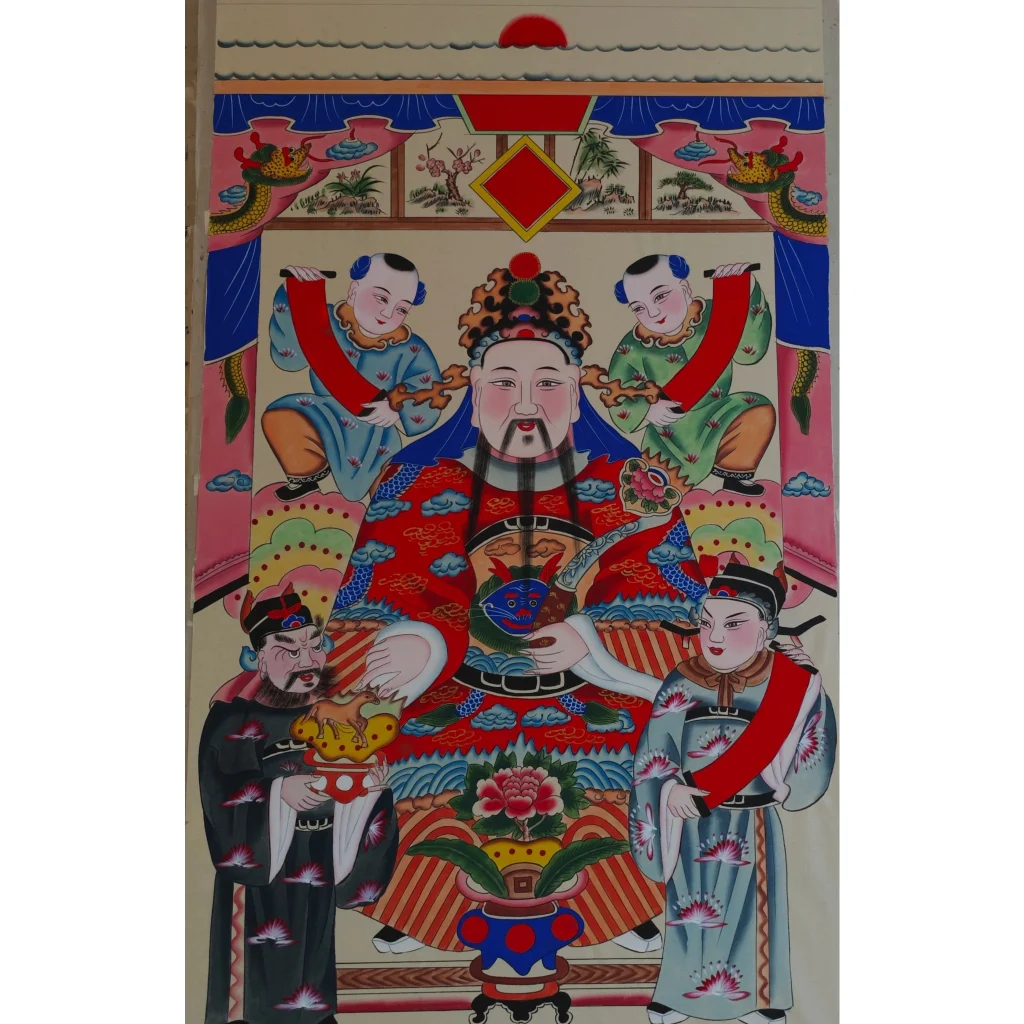
If you have ever walked into a Chinese restaurant, shop, or family home and noticed a smiling figure holding a gold ingot or a scroll overflowing with coins, you have encountered the God of Wealth. Known in Chinese as Caishen (财神), he is one of the most widely recognized and beloved deities in Chinese folk tradition. But who exactly is he, and why does his image appear everywhere during the Lunar New Year?
The God of Wealth is a deity in Chinese folk religion and mythology associated with prosperity, good fortune, and abundance. Unlike a single fixed figure, the title “Caishen” actually refers to a family of wealth deities, each with its own origin story and regional following. In many traditions, Caishen is further divided into the Civil God of Wealth (文财神) and the Martial God of Wealth (武财神).
The most commonly depicted version is Zhao Gongming (赵公明), a warrior-deity who is usually venerated as the Martial God of Wealth. According to legend, he was granted dominion over wealth and prosperity after his death. Other popular figures include Bi Gan (比干), a loyal minister known for his integrity, and Fan Li (范蠡), a brilliant strategist who became one of the richest merchants in ancient China. These two are often regarded as Civil Gods of Wealth.
What unites all these figures is a shared cultural idea: wealth is not merely about money, but about virtue, wisdom, and fair dealing. The God of Wealth blesses those who work hard and conduct themselves with integrity.
This is a question many people ask. The God of Wealth is both. In religious practice, he is honored as a genuine deity with temples dedicated to him across China and throughout the Chinese diaspora. In everyday culture, he also functions as a powerful symbol — a visual reminder of aspirations for prosperity, security, and a better life for one’s family. His image is not worshipped in the same way as a major religious figure might be; rather, he is invited into spaces as a bearer of good fortune and positive energy.
The historical roots of the God of Wealth stretch back over two thousand years. Zhao Gongming, the most widely recognized Caishen, first appears in written records during the Han Dynasty (206 BCE – 220 CE) as a Taoist deity associated with the plague and healing. Over centuries, his role evolved. By the Ming Dynasty (1368–1644 CE), the classic novel Investiture of the Gods (封神演义) cemented his identity as the God of Wealth, placing him in charge of four subordinate deities who govern treasure, profit, recruitment, and trade. This literary portrayal shaped how Caishen is imagined to this day.
It is worth noting that the God of Wealth is not a figure confined to the past. He remains a living presence in contemporary Chinese culture, invoked during Lunar New Year celebrations, displayed in shops and offices, and featured on decorative objects meant to attract prosperity.
Traditional imagery of the God of Wealth follows a recognizable pattern. He is often shown as a robust, smiling man wearing the robes of a high-ranking official from the Ming or Qing Dynasty. In one hand he typically holds a Ruyi scepter (如意) or a scroll inscribed with auspicious phrases; in the other, a gold ingot (元宝). Sometimes he is accompanied by a treasure bowl overflowing with coins, or by children symbolizing fertility and familial prosperity. The color red — associated with good luck in Chinese culture — frequently appears in his attire and surroundings.
In more recent and stylized interpretations, the God of Wealth is rendered in porcelain, carved wood, cast bronze, and other traditional craft materials. These decorative pieces are not merely art objects; they carry cultural meaning and are often placed in entryways, living rooms, or business premises as a way of “inviting wealth in.”
In Shandong, especially around Gaomi, the image of Caishen has long been one of the most popular subjects in Puhui New Year painting (扑灰年画). These are hand-painted works on xuan paper, often mounted as scrolls, and they have been circulated among ordinary families for generations. During the Lunar New Year, people hang Caishen scrolls in main halls, shops, and entryways to invite wealth and good fortune. The local style is bold, warm, and festive: red and gold tones dominate, Caishen appears robust and smiling, and auspicious symbols such as gold ingots, treasure bowls, and ruyi scepters are rendered with lively folk brushwork. Because these paintings were traditionally made in small family workshops, they became deeply embedded in folk life and are still prized for their handmade warmth and regional character. For most people, an artisan-level Caishen painting is the most popular choice, while a master-level Caishen painting is chosen by those who place greater emphasis on fine artistry and collectibility.Some martial arts practitioners also like to hang a Martial God of Wealth painting — the Caishen image of Guan Yu (Guan Gong), the Martial God of Wealth.
The busiest time of year for the God of Wealth is undoubtedly the Lunar New Year. On the fifth day of the new year, known as “Welcoming the God of Wealth Day” (迎财神), families and businesses set off firecrackers and make offerings to invite Caishen into their homes and shops for the coming year. It is believed that the earlier you welcome him, the more prosperity he will bring. Images of the God of Wealth are also pasted on doors and walls, much like door gods, as a protective and auspicious decoration.
This tradition reflects a deeply held cultural value: the desire for a prosperous year is not seen as greed, but as a legitimate hope for the well-being of one’s family and community.
In a modern, globalized world, the God of Wealth endures because he represents something universal — the hope for abundance, security, and good fortune. For Chinese communities around the world, his image is a link to cultural heritage and family tradition. For others, he offers a window into Chinese values around work, integrity, and the meaning of prosperity.
Whether displayed as a finely crafted porcelain figurine, a carved wooden plaque, a hand-painted xuan paper scroll, or a simple paper print, the God of Wealth continues to remind us that the pursuit of prosperity, when grounded in virtue, is a noble and timeless aspiration.
A: The God of Wealth, known as Caishen (财神), is a deity in Chinese folk religion associated with prosperity and good fortune. The most widely recognized figure is Zhao Gongming, though several historical figures share the title.
A: The God of Wealth is both a revered deity in Chinese folk religion and a cultural symbol of prosperity, integrity, and abundance. His image is commonly displayed in homes, shops, and restaurants.
A: The God of Wealth’s origins date back over 2,000 years. Zhao Gongming was first recorded during the Han Dynasty, and his identity as the God of Wealth was cemented by the Ming Dynasty novel Investiture of the Gods.
A: Yes. In Shandong, especially around Gaomi, Puhui New Year paintings feature hand-painted Caishen scrolls on xuan paper. They are widely circulated in folk culture and are still hung during Lunar New Year to welcome wealth and good fortune.
A: Yes. The God of Wealth remains a living presence in Chinese culture, especially during Lunar New Year celebrations, and his image continues to be featured in traditional craft and decorative objects worldwide.