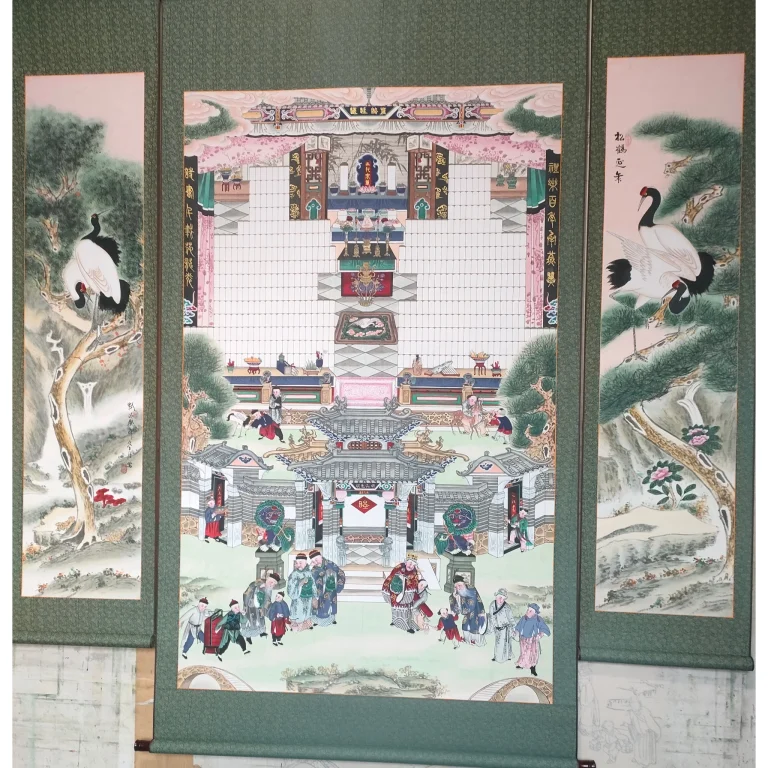

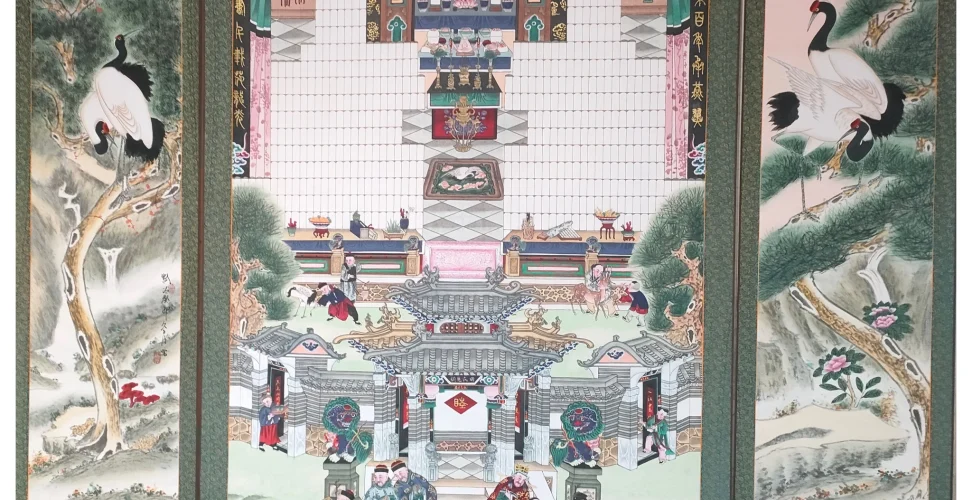
The Chinese ancestor painting, also known as the family tree scroll, family portrait, clan portrait, or ancestral portrait — with different names across regions — is known as “Jiaying” in Laizhou, Shandong, commonly called “Gua Zhuzi” (hanging bamboo) in Gaomi, and “Zhouzi” in Laixi, Qingdao. It is a large scroll painting used for ancestral worship during the Spring Festival, recording a family’s genealogy. The scroll is substantial in size — typically about 1.1 to 1.5 meters wide and 1.7 to 2 meters tall — designed to be hung prominently in the center of the main hall.
Its composition follows strict traditional rules. The painting is divided into several sections from top to bottom: the top section depicts pavilions, towers, pine trees, and bamboo as auspicious symbols; the middle section features an altar table with an ancestral tablet inscribed with “The Honored Ancestors of All Generations”; below this, on both sides of a central pathway, are arranged grids in which the names of deceased ancestors are recorded in order of seniority — arranged with males on the left, females on the right, and couples placed symmetrically. The entire scroll resembles a flat, unfolded ancestral hall, blending the overall appearance of a family temple with the names of ancestors — a testament to the wisdom of Chinese folk artisans.
The rituals of hand-painted Chinese ancestor painting are not mere folk customs — they are grounded in verifiable historical records and established rites:
Sima Guang‘s “Book of Etiquette for the Sima Family” (Northern Song Dynasty) records that painting ancestral portraits and establishing halls to honor ancestral spirits was an established ritual for scholar-officials and prominent families of the Song Dynasty to reverently honor their ancestors — establishing the ritual foundation for ancestral portrait worship.
“The Surviving Works of the Two Chengs” (Northern Song Dynasty) emphasizes that ancestral portraits must be rendered with absolute accuracy, painted with reverence and dignity, without carelessness or casualness. Only those who are knowledgeable in ritual and virtuous in character may hold the brush — this is the only way to preserve the true spirit of ancestral veneration — establishing the principle that only Chinese ancestor painting by virtuous artists is worthy.
Zhu Xi‘s “Family Rituals” (Southern Song Dynasty) explicitly states: compiling family genealogies and painting ancestral portraits are essential duties for honoring ancestors, revering the clan, and uniting family members. These tasks must be undertaken by the clan‘s respected elders and scholar-artists, who must work with reverence and strict adherence to ancient traditions — reinforcing the importance of Chinese ancestor painting as a sacred act.
Clan genealogies of the Ming and Qing dynasties, as well as folk custom records from northern China and the Huizhou region all document that whenever clan ancestral halls commissioned the repainting of ancestral scrolls, they would select elderly, virtuous, and respected members who were skilled in calligraphy and painting to serve as the principal artists — upholding the family tradition of “no painting without virtue, no completion without ritual.”
According to ancient tradition, whenever a clan revised its genealogy or commissioned new ancestral portraits, the family would collectively recommend virtuous, respected, knowledgeable in ritual and literature, and accomplished in both calligraphy and painting — a sage or refined scholar — to purify themselves, wash their hands, and respectfully execute the painting with the brush.
Only those who are sincere in heart and possessed of moral authority may apply the brush — their strokes dignified, their compositions solemn — thereby matching the dignity of the ancestors, fulfilling the descendants‘ sincere reverence, and conforming to the orthodox rituals of the clan.
Folk records show that in the past, when commissioning an ancestral scroll, the family would entrust a respected clan member with exceptional calligraphy skills to fill in the names of the ancestors in proper order within the central grid. There are also strict rules for name placement: the left side records male names, with direct lineage placed closer to the center; the right side records female names in corresponding positions. In the past, under the influence of traditional patriarchal customs, many women had no formal given names and were recorded as “née [surname].”
The rituals for hanging and worshipping are equally strict. On the evening of New Year’s Eve, the head of the household, after purifying his hands, would reverently hang the ancestral scroll on the north wall of the main room, flanked by auxiliary scrolls featuring lotuses, peonies, or matching couplets. The north wall must be a solid wall — there must be no holes, gaps, or windows on it. If the wall had any openings, the family would hang a straw mat as padding before the scroll. This detail embodies the spatial ritual requirement of “establishing the ancestral spirit, continuing the family line.”
The hanging and rolling up of the Chinese ancestor painting follow a fixed schedule. Traditionally, on New Year‘s Eve, the eldest son or grandson would “invite” the scroll out in the afternoon and carefully unroll it for display — this is the heart of the “Inviting the Ancestors” ceremony, symbolizing welcoming the ancestors back home to share the reunion dinner. Offerings such as the three sacrificial meats, five fruits, an odd number of dishes, dumplings, and other foods are placed on the altar table, and the family pays homage in order of seniority.
On the third day of the New Year, the scroll is taken down and rolled up — this is called “Lowering the Shadow” or “Completing the Year,” meaning the ancestors are sent off. On the Lantern Festival (the 15th day of the first month), the scroll is hung once more, symbolizing the ancestors‘ return home for a second reunion. On the 16th day of the first month, it is formally rolled up and stored away.
During the hanging period, the family observes many taboos — such as not speaking carelessly and not calling children by their names, to avoid offending the ancestors‘ names. These rules, on the surface, may appear to be prohibitions, but they are in fact an outward expression of reverence for the ancestors. The entire process revolves around the Chinese ancestor painting, which serves as the focal point of the ceremony.
The ancient tradition insists on hand-painted ancestral scrolls — no painting without virtue, no completion without ritual. Through the artist‘s brush, the dignified image of the ancestors is preserved; through orthodox hand-painting, the family ethos is passed down through generations.
In earlier times, ancestral scrolls were mostly hand-painted by folk artists. In Weifang and Gaomi, Shandong, the production of these scrolls was closely linked to the local “Puhui New Year Painting” craft — and those capable of painting ancestral scrolls were considered the most skilled masters in the trade. Painting a large ancestral scroll required setting up scaffolding, much like building a stage for a performance — an impressive spectacle that attracted considerable attention.
In contrast to the abundance of machine-printed replicas available today, authentic ancestral scrolls that truly embody the ritual spirit are always hand-painted — each brushstroke and each scroll crafted with devotion. It is a sacred act that continues to honor the ancient tradition of Chinese ancestor painting, preserving the essence of the ritual. Today‘s artisans inherit the original intentions of ancient masters, adhering to the ritual systems of the Song and Ming dynasties and the ancient hand-painting methods — creating every ancestral scroll with devout sincerity and orthodox brushwork, preserving the spirit of Chinese ancestor painting.
The enshrinement of a hand-painted ancestral scroll is not merely an act of honoring ancestors, preserving their memory, and uniting the clan — it also serves to uphold family integrity, consolidate the family‘s foundation, bless future generations, and bring glory to the household — a solemn ritual through which great families pass down their cultural heritage.
As documented in Laizhou folk customs, the tradition of “family portrait” culture is “a symbol of practicing Chinese virtues and celebrating an auspicious era.” It is not merely a painting — it is a visible family archive, a silent lesson in family values.
Though time flows on, the ancient methods have never been severed. Today, artisans inherit the original intentions of ancient masters, strictly observing the rituals of the Song and Ming dynasties and the traditional hand-painting methods. With devout sincerity and orthodox brushwork, they reverently paint each ancestral scroll. Every brushstroke follows ancient rites; every scroll honors the ancestors — ensuring that the solemn rituals and family traditions of the Chinese clan endure for generations, and the household flourishes in glory.
One Response
Hi, this is a comment.
To get started with moderating, editing, and deleting comments, please visit the Comments screen in the dashboard.
Commenter avatars come from Gravatar.